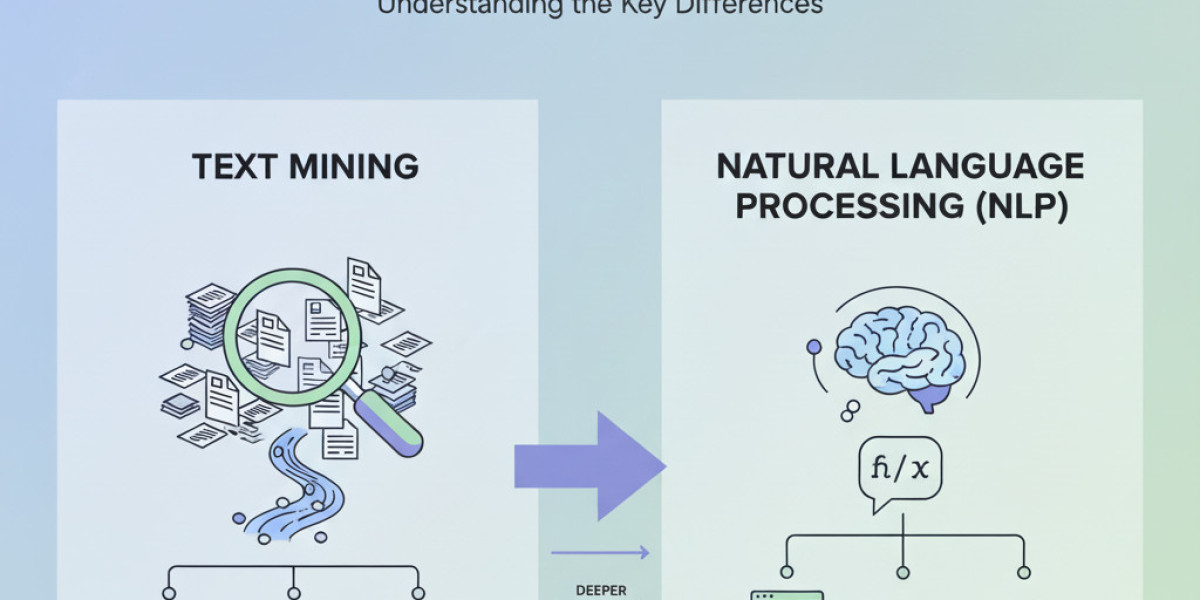
In the contemporary digital era, textual information is ubiquitous, text-based communications such as emails, reviews, chat messages, and social media posts contain useful information. Text Mining and Natural Language Processing (NLP) are two very strong technologies that are usually applied to make sense of this unstructured information. Although there is a close relationship between them, they are used to know and study language differently. Let us see the difference between them and their cooperation.
What Is Text Mining?
Text mining is the art of deriving information and trends out of large volumes of text. It breaks down unstructured text into structured information which can also be analyzed into insights.
As an illustration, text mining can be used when the companies examine thousands of customer reviews to detect the most commonly used words, common complaints or positive feedback trends. It is concerned with what is said and how frequent it comes out.
Text mining often employs such common techniques as tokenization (division of the text into words), frequency analysis of words, similarity of topics, and sentiment detection. When these methods are applied, data can be analyzed in such a manner that organizations can tell the hidden patterns that otherwise are not being realized in plain text.
Concisely, text mining assists in transforming large quantities of written data into insightful information that can be put into action.
What Is Natural Language Processing (NLP)?
Natural Language Processing/ NLP is a part in artificial intelligence which allows computer to comprehend and interpret human language. It is concerned with text meaning, grammar and content as opposed to counting words.
NLP drives most of the tools we use on a daily basis such as chatbots, translation apps, virtual assistants, and email filters. It aids the machines to understand the tone, emotion and intent of human communication.
The identification of parts of speech, names and places, language translations and speech conversions are some of the essential NLP tasks. NLP fills the gap between what human beings can say and what computers can comprehend in a way that there is easy interaction between the people and the computers.
The main Disagreements between Text Mining and NLP.
Their purpose and focus are the major difference. The goal of Text mining is to understand and unearth valuable patterns in the text data, whereas the goal of NLP is to enable the computers to read and comprehend language.
Text mining is more statistical and analytical in extracting trends whereas NLP is more linguistic and AI-based in understanding the pattern and meaning of language.
As an illustration, when a firm wishes to know the views of customers regarding a product, text mining can be used to determine which words are used most frequently like fast, expensive or durable. Instead, NLP is able to establish whether such words are used in a positive or negative context.
The two processes have a common data source; emails, reviews or articles and yet have a different end objective. Text mining summarizes what the data tells us, whereas NLP tells us why the data tell so.
The work of the Text Mining and NLP.
Although they are not similar, text mining and NLP tend to go together. The basis of the NLP is to assist computers in text meaning and structure. That knowledge is then used by the text mining to cut valuable patterns and insights.
As an example, when examining customer feedback, NLP initially assists in the detection of emotions, discovery of important topics, and interpretation of sentence meaning. Those insights are then clustered together in text mining to indicate trends, including a set of common complaints about a product feature or a service enhancement.
Such a combination assists businesses to make data-driven decisions, enhance customer satisfaction, and forecast upcoming trends through actual feedbacks.
Conclusion
Two of the most effective methods that help interpret the masses of text data that are generated every day are text mining and NLP. Text mining is concerned with the identification of patterns and summarization of information whereas NLP is concerned with the comprehension and interpretation of the human language.
They combine to achieve the transformation of raw text into meaningful insight. Both technologies are important in closing the gap between data and interpretation whether it is gathering the customer views, reviewing the research papers and enhancing communication devices.
The combination of text mining and NLP will continue to influence the context through which we interpret information, form judgments and engage with machines in the contemporary world, as technology keeps on changing.